The pharmaceutical manufacturing landscape is evolving rapidly.
Today's Contract Development and Manufacturing Organisations (CDMOs) are expected to support more therapeutic modalities, more sponsor programmes and faster development timelines than ever before. At the same time, they must maintain the highest standards of operator safety, product quality and regulatory compliance.
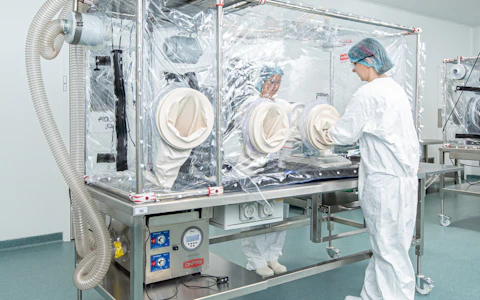
Containment remains a foundational requirement, but the role of containment is changing. It is no longer viewed solely as a safety measure. Increasingly, it is becoming a strategic tool that enables flexible manufacturing, faster changeovers and operational agility.
So what are the trends shaping the future of pharmaceutical containment?
1. Facilities are supporting more modalities than ever
The era of the single-product facility is fading. Many CDMOs now support a diverse mix of manufacturing programmes that may include ADCs, HPAPIs, cell and gene therapies, biologics, viral vectors, and emerging therapeutic platforms.
This diversification creates new containment challenges because each modality introduces distinct process, exposure and contamination-control requirements.
The rapid growth of ADC development illustrates this trend. Industry reports indicate continued expansion in both ADC pipelines and manufacturing investments, increasing demand for specialised manufacturing and containment capabilities.¹²
The challenge for CDMOs is no longer simply containing potent compounds. It is maintaining flexibility while supporting a constantly changing portfolio of therapies.
2. Flexibility is becoming more valuable than permanence
Historically, manufacturers invested in fixed containment infrastructure designed for a specific process or product. Today's environment is different. Projects change. Customers change. Manufacturing priorities change.
As a result, many facilities are shifting toward flexible and modular manufacturing strategies capable of adapting rapidly to new programmes without extensive facility modifications.³
Containment solutions must evolve with the same mindset.
3. Faster changeovers are becoming a competitive advantage
For CDMOs, downtime directly impacts capacity utilisation and revenue. Every day spent installing infrastructure, modifying equipment or validating facility changes delays the next manufacturing campaign.
Leading facilities are increasingly seeking containment approaches that minimise disruption, reduce installation time, simplify changeovers and preserve validated workflows.³⁴
Operational agility has become a competitive advantage.
4. Existing equipment is being preserved
Most manufacturers have invested heavily in reactors, filling systems, powder-handling equipment, analytical instrumentation and process skids. Replacing these systems often triggers costly revalidation efforts and operational disruption.
As a result, many manufacturers are pursuing containment strategies engineered around existing assets rather than replacing them entirely.
For many organisations, the most effective containment solution is not the one that replaces their workflow. It is the one that works seamlessly within it.
5. Operator experience matters more than ever
Containment performance alone is no longer enough. Manufacturers increasingly evaluate ergonomics, visibility, workflow efficiency, accessibility and ease of maintenance when selecting containment solutions.
Recent ISPE guidance continues to emphasise evaluating containment solutions in ways that support both worker protection and efficient operations.⁵⁶
The best containment systems protect operators without slowing them down.
6. Regulatory expectations continue to rise
Containment is becoming more closely linked with contamination control and overall pharmaceutical quality systems.
The revised EU GMP Annex 1 guidance reinforced industry expectations around contamination control, risk management, documentation, environmental monitoring, and quality oversight.⁷ Perhaps most significantly, Annex 1 increased emphasis on comprehensive Contamination Control Strategies (CCS) that evaluate risk across facilities, processes, equipment, personnel and materials.⁸⁹
While regulations vary globally, the direction is clear: manufacturers must demonstrate robust, repeatable containment strategies that support both worker safety and product quality.
Containment is no longer viewed as an isolated engineering function. It is increasingly considered an essential component of an organisation's overall quality strategy.
7. Workflow-centred engineering is emerging as a competitive differentiator
Perhaps the most significant shift is not technological. It is philosophical.
Manufacturers are asking a different question.
Instead of:
"What containment system should we buy?"
They are asking:
"How can we achieve containment without disrupting how we already work?"
Organisations increasingly seek containment solutions that integrate with existing workflows and validated equipment rather than requiring extensive process redesign.
As manufacturing becomes more complex, workflow-centered engineering is emerging as a meaningful competitive advantage. Containment is no longer simply equipment. It is becoming an enabler of manufacturing agility.
Final thoughts
The future of pharmaceutical manufacturing belongs to organisations that can adapt quickly while maintaining the highest standards of safety, quality and compliance.
As therapeutic modalities continue to evolve and manufacturing demands become more complex, successful containment strategies will balance protection with operational flexibility.
At ONFAB, we believe the most effective containment solutions are those designed around the realities of manufacturing. Solutions that support existing workflows, preserve validated equipment and help organisations respond faster to changing production requirements.
References
1. PharmaSource. ADC Contract Manufacturing Services & Market Report 2026. [pharmaceut...nology.com]
2. Pharmaceutical Technology. ADCs on the Rise: Manufacturing Investments and Market Growth. [cphi-online.com]
3. PharmaBoardroom. Key CDMO Trends to Know in 2025: Scale, Specialisation, Digital. [visionlife...iences.com]
4. ProGen Search. The Evolving CDMO Landscape: Navigating a More Selective Future. [thermofisher.com]
5. ISPE. Assessing Containment Equipment and Systems with New ISPE Guide. [ispe.org]
6. ISPE. Containment Topic Overview. [qualia-bio.com]
7. European Commission. EU GMP Annex 1: Manufacture of Sterile Medicinal Products (2022 Revision). [intuitionlabs.ai]
8. PDA. EU GMP Annex 1: Implementation of Contamination Control Strategy. [gmp-publishing.com]
9. GMP Publishing. New in Annex 1: The Contamination Control Strategy (CCS). [ispe.org]