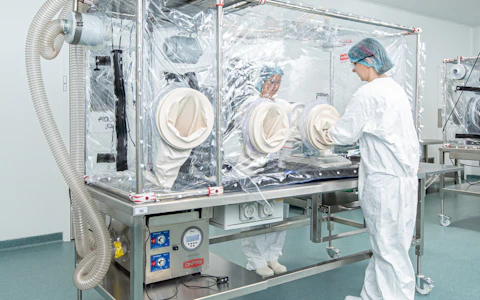
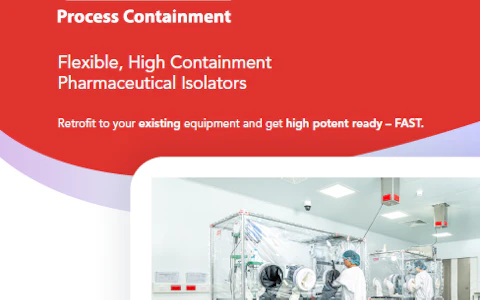
For CDMOs and multiproduct pharmaceutical manufacturers, cleaning is essential. But it is also expensive.
Most manufacturers calculate cleaning costs in terms of labour, cleaning agents and validation activities. Those costs matter. But they are only part of the story.
The larger cost is often hidden.
Every hour spent cleaning, verifying, documenting, inspecting and releasing equipment is an hour that manufacturing assets are not producing.
As CDMOs manage increasingly diverse product portfolios, support more customer programmes, and handle a growing number of highly potent compounds, this hidden cost becomes increasingly significant.
The question is no longer simply:
"How do we clean faster?"
A more strategic question is:
"How much cleaning can we design out of the process altogether while maintaining containment, product protection, and regulatory compliance?"
Cleaning Is a Manufacturing Strategy, Not Just a Maintenance Activity
In pharmaceutical manufacturing, cleaning serves a critical purpose.
FDA guidance makes clear that non-dedicated equipment used for multiple products must be appropriately cleaned to prevent contamination and carryover. Cleaning validation programmes are expected to demonstrate that cleaning procedures consistently reduce residues to scientifically justified acceptable levels.
European regulatory guidance takes a similar risk-based approach. EMA emphasises the use of health-based exposure limits and documented risk assessments when establishing cross-contamination control strategies within shared facilities.
For CDMOs, these expectations are especially important because the same equipment may support multiple customers, products, and potency levels.
The challenge is not simply:
Can we clean it?
It is:
Can we clean it consistently, document the process, demonstrate acceptable residue levels, release the asset and return it to production efficiently?
That distinction transforms cleaning from a maintenance activity into a capacity-management issue.
Potent Compounds Increase Both Risk and Complexity
As highly potent APIs become more common, contamination-control strategies become increasingly important.
Regulators expect manufacturers handling potent compounds to establish appropriate containment and cross-contamination controls based on risk.
But containment and cleaning cannot be evaluated independently.
A containment system may provide excellent operator protection during manufacturing. The operational challenge begins when the campaign ends.
Manufacturers must then consider:
- Which surfaces have been exposed?
- Which components require cleaning?
- Which areas are difficult to access?
- What sampling is required?
- What documentation must be completed?
- How long before equipment can return to service?
For high-potency operations, the complexity of these activities can increase substantially.
As a result, cleaning performance becomes directly connected to manufacturing efficiency.
The Hidden Variable: Time
Cleaning carries obvious direct costs.
However, for many CDMOs, the most significant cost may be lost manufacturing availability.
Consider a typical product changeover:
Campaign Complete → Breakdown → Cleaning → Inspection → Sampling → Testing → Documentation → Release → Setup → Next Campaign
Each stage adds time before manufacturing can resume.
FDA guidance recognises that equipment design, accessibility, sampling requirements, cleaning methods and cleaning validation activities can all influence the complexity of the process.
For a dedicated manufacturing line running the same product continuously, these requirements may represent a manageable overhead.
For a multiproduct facility changing campaigns regularly, the economics are very different.
Changeover time becomes capacity.
Capacity becomes revenue potential.
The facilities capable of reducing nonproductive time often gain a significant competitive advantage.
Looking Beyond the Purchase Price of Containment
Containment decisions are often evaluated using a familiar metric:
"What does the containment system cost?"
The problem is that this question captures only a portion of the economic picture.
A more complete assessment considers the long-term operational consequences of the containment strategy.
Flexible and single-use containment solutions introduce another variable:
The ability to remove and replace selected containment components rather than repeatedly cleaning them between campaigns.
This does not eliminate cleaning requirements.
Process equipment, reusable interfaces, and other exposed components may still require appropriate cleaning and validation activities. Single-use technologies do not replace risk assessments or contamination-control strategies.
However, they can significantly reduce the amount of reusable containment surface requiring cleaning and verification.
That shifts the economic discussion from acquisition cost to operational impact.
The question becomes:
"What does this containment strategy cost over hundreds of changeovers?"
Designing Out Cleaning Where It Creates Value
This is not an argument for making everything disposable. In most manufacturing environments, existing process equipment represents significant capital investment, validation effort and operational expertise.
Replacing proven equipment simply to support a different containment philosophy rarely makes economic sense.
Instead, manufacturers should evaluate where reusable systems create value and where single-use technologies create value.
A hybrid approach often allows organisations to:
- Retain validated process equipment
- Preserve existing workflows
- Reduce cleaning burden
- Increase flexibility
- Simplify campaign transitions
- Improve manufacturing responsiveness
This approach can be particularly attractive for facilities managing:
- Multiple products
- Frequent campaign changes
- Varying potency levels
- Existing installed equipment
- Diverse customer requirements
- Space limitations
- Complex operator interactions
The objective is not maximum disposability.
The objective is maximum operational efficiency while maintaining required containment performance and product protection.
The Real Cost of Cleaning
Many cleaning-related expenses do not appear under a containment budget. Yet they influence the economics of every manufacturing campaign. These costs often include:
Labour
Disassembly, cleaning, inspection, reassembly and preparation activities all require skilled personnel.
Validation
Cleaning processes must be demonstrated to perform consistently where validation is required.
Sampling and Testing
Swab sampling, rinse testing, analytical methods, investigations and review activities consume both time and resources.
Documentation
Procedures, batch records, validation protocols, reports, and approvals create significant administrative requirements.
Equipment Accessibility
Complex geometries, difficult-to-access surfaces, and intricate assemblies can substantially increase cleaning effort.
Production Downtime
Perhaps the most important factor of all.
Every hour spent preparing equipment for the next campaign represents time that manufacturing assets are unavailable for production.
These costs may not appear under a line item called "containment."
But they are often determined by the containment strategy.
Cross-Contamination Risk Is Also an Economic Issue
The strongest rationale for reducing cleaning complexity is not purely financial. It is also about risk reduction.
Both FDA and EMA emphasise the importance of controlling contamination and carryover when shared equipment is used for different products.
Traditional cleaning strategies manage contamination after surfaces have been exposed. A thoughtfully designed containment strategy may reduce the number of exposed reusable surfaces altogether.
This does not eliminate the need for risk assessments, validation activities or regulatory controls but it can change how risk is managed.
Rather than focusing entirely on cleaning exposed surfaces, manufacturers may be able to reduce the number of surfaces that require cleaning in the first place. That distinction can have meaningful operational value.
Start With the Workflow
The most effective containment strategies rarely begin with equipment specifications.
They begin with the manufacturing process. Ask:
- Where can exposure occur?
- What equipment already exists?
- Which surfaces contact product?
- What requires cleaning between campaigns?
- Where are the difficult-to-clean interfaces?
- How frequently do products change?
- What must operators access?
- How are materials transferred?
- What does a day of additional manufacturing availability mean to the business?
These questions shift containment discussions from equipment procurement to manufacturing strategy.
The Real Economics of Containment
For CDMOs, containment economics extend far beyond CAPEX.
A more complete equation is:
Containment CAPEX + Cleaning + Validation + Labour + Testing + Documentation + Waste + Changeover Time + Manufacturing Capacity + Cross-Contamination Risk
Every facility will arrive at a different answer.
A dedicated manufacturing line may justify one approach.
A multiproduct CDMO managing frequent customer transitions may justify another.
That is precisely why containment decisions should be evaluated through the lens of operational performance, not simply equipment acquisition cost.
The most valuable question may not be:
"How can we clean faster?"
It may be:
"How much cleaning can we safely design out of the process?"
For CDMOs managing increasingly diverse customer portfolios, the answer can influence far more than cleaning costs.
It can influence changeover time, facility utilisation, manufacturing capacity, operational agility, and the ability to secure the next customer programme.
Containment Should Enable Capacity, Not Create Constraints
As product portfolios become more complex and manufacturing schedules become more dynamic, containment decisions influence far more than operator protection and regulatory compliance. They influence how quickly facilities can adapt to new customer requirements, transition between campaigns, and maximize the utilisation of valuable manufacturing assets.
The most effective containment strategies are not designed solely around today's process. They are designed for the reality of multiproduct manufacturing, where flexibility, containment performance and operational efficiency must work together.
For many CDMOs, the question is no longer simply how to clean faster. It is how to reduce unnecessary cleaning while maintaining the containment performance, product protection, and quality standards their operations require.
At ONFAB, we help manufacturers evaluate containment through the lens of the entire manufacturing workflow, balancing operator protection, process flexibility, asset utilisation and long-term operational efficiency.
Because the true economics of containment extend well beyond the initial purchase price.
Containment that fits your workflow.
Not the other way around.
Independent Sources
- FDA – Guide to Inspections: Validation of Cleaning Processes
- FDA ICH Q7 Good Manufacturing Practice Guidance for Active Pharmaceutical Ingredients
- FDA CGMP Questions and Answers: Equipment and Cleaning Validation
- EMA Guideline on Setting Health-Based Exposure Limits for Use in Risk Identification in the Manufacture of Different Medicinal Products in Shared Facilities
- EMA Questions and Answers on Health-Based Exposure Limits and Cross-Contamination