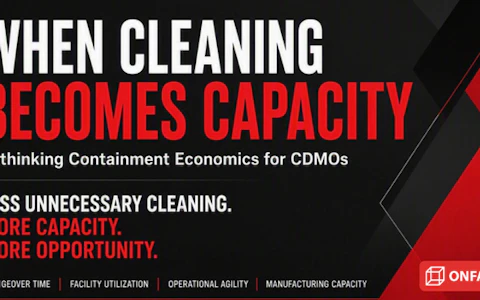
A disposable assembly may cost more than the stainless-steel component it replaces. But for a contract development and manufacturing organisation (CDMO), that is rarely the most important economic comparison.
When evaluating single-use technologies, discussions often focus on component cost. A stainless-steel vessel, fitting, or transfer system may appear less expensive over its useful life, while a single-use assembly must be replaced for each manufacturing campaign.
But focusing solely on acquisition cost overlooks the broader economics of modern biopharmaceutical manufacturing.
For CDMOs, profitability depends on far more than component cost. It is influenced by how efficiently manufacturing capacity can be converted into revenue-generating campaigns while maintaining the flexibility to support an evolving customer portfolio.
The more meaningful question is not:
“Which component costs less?”
It is:
“Which manufacturing strategy creates the best combination of cost, capacity, and flexibility?”
Look beyond the component
Traditional stainless-steel manufacturing systems often require far more than the equipment itself. Depending on the application, facilities may require:
- Clean-in-place (CIP) systems
- Steam-in-place (SIP) systems
- Water-for-Injection (WFI) generation and distribution
- Clean steam infrastructure
- Cleaning chemicals
- Fixed piping and instrumentation
- Cleaning validation programmes
- Preventive maintenance
- Additional labour
- Dedicated facility space
Single-use technologies can eliminate or significantly reduce many of these requirements.
A 2023 review by Whitford and Szafir reported that facilities designed around single-use technologies have often demonstrated initial investments approximately 50% lower than conventional multi-use stainless-steel facilities. The authors also cited reported reductions in water and energy consumption approaching 46% in certain facility designs. These outcomes are highly dependent on facility configuration and process requirements, but they illustrate an important point:
The real comparison is not disposable versus stainless steel.
It is the infrastructure, utilities, validation activities, labour requirements, and operating model required to support each manufacturing strategy.
Capacity has value. Downtime has cost.
In manufacturing, an idle asset generates no revenue.
Before a stainless-steel system can be used for the next campaign, it typically must be cleaned, sterilised, inspected, documented and released for production. While these activities are essential, they also consume time.
For a CDMO supporting multiple customers and products, that time carries a significant opportunity cost. Every day spent preparing equipment for the next campaign is a day that manufacturing capacity cannot be used for another revenue-generating programme.
Reducing changeover activities can therefore create something extremely valuable: Available manufacturing capacity.
This is particularly important in multi-product facilities, where transitions between customer programmes may occur frequently.
Economic analyses published by Garcia and Gefroh have shown that facility utilisation and manufacturing demand can significantly influence overall production economics. Their work reinforces the importance of looking beyond equipment acquisition cost when evaluating manufacturing strategies.
For CDMOs, the critical question becomes:
“How much productive capacity can this manufacturing strategy create?”
Not simply:
“How much does this equipment cost?”
Flexibility is a financial asset
CDMOs operate in environments defined by change. Customer pipelines evolve. Demand forecasts shift. Clinical programmes advance - or stop. Batch sizes change. New modalities emerge. Manufacturing requirements evolve.
Facilities may need to accommodate:
- New customers
- Different therapeutic modalities
- Varying batch sizes
- Clinical-to-commercial transitions
- Evolving process equipment
- Market-driven demand changes
- New production technologies
The growth of advanced therapies such as antibody-drug conjugates (ADCs), cell and gene therapies, mRNA platforms, and next-generation biologics has further increased the importance of flexible manufacturing environments.
A highly fixed facility may be extremely efficient when demand is stable, predictable and sustained.
But when products, processes and production requirements change frequently, flexibility itself becomes an economic asset.
This does not mean single-use technologies are always the lowest-cost option. They are not. Instead, manufacturers should ask:
“What manufacturing architecture best aligns with how this facility actually operates?”
For a facility producing the same product at high volume for many years, stainless steel may remain economically attractive. For a multi-product CDMO managing diverse customer programmes and frequent changeovers, the equation can look very different.
Sustainability requires the same total-system thinking
The sustainability discussion surrounding single-use technologies often focuses on the most visible difference: plastic waste. While that concern is understandable, environmental impact should be evaluated from a total lifecycle perspective.
A 2022 lifecycle assessment involving researchers from organisations including Genentech/Roche, GSK, Merck and the ACS Green Chemistry Institute examined a 2,000L single-use biologics manufacturing process. The study found that electricity consumption represented the largest contributor to environmental impact across many categories, while end-of-life impacts associated with plastic single-use technologies were comparatively small.
More recent research published in the Journal of Cleaner Production in 2026 compared laboratory-scale stainless-steel and single-use bioreactor systems using primary industrial data. Under the study’s baseline conditions, the single-use system demonstrated lower environmental impacts across all sixteen categories evaluated, although the authors also noted that end-of-life disposal methods can significantly influence environmental performance.
The lesson is not that disposable automatically means sustainable. Rather, sustainability decisions often follow the same logic as economic decisions: The complete system matters more than any single visible input.
Process efficiency, facility utilisation, energy and water consumption, cleaning requirements and operational design all contribute to the overall environmental footprint.
The real business case starts with total cost
When evaluating manufacturing strategies, CDMOs should look beyond acquisition price. The true economic equation includes:
CAPEX + Utilities + CIP/SIP + Cleaning + Validation + Maintenance + Labour + Changeover Time + Facility Utilisation + Flexibility
And perhaps the most overlooked variable of all:
What is the value of getting the facility back into production sooner?
Every hour of available manufacturing capacity represents an opportunity to support another batch, accelerate another programme or accommodate another customer project.
For a CDMO, those hours can have real economic value.
That is why the most important question may not be:
“Which component costs less?”
It may be:
“Which manufacturing strategy provides the best combination of cost, capacity, and flexibility for the programmes we need to support?”
For today’s CDMOs, that is where the real business case begins.
Sources
- Whitford, W. & Szafir, A. Hybrid Design Considerations in Biomanufacturing: Leveraging Both Stainless-Steel and Single-Use Systems. BioProcess International, 2023.
- Garcia, M. & Gefroh, E. Economic Drivers in Modern Biopharmaceutical Manufacturing. Drug Discovery Today, 2023.
- Budzinski, M. et al. Life Cycle Assessment of a 2,000-L Single-Use Biologics Manufacturing Process. New Biotechnology, 2022.
- Gonzalez Monroy, J. et al. Life Cycle Assessment of Stainless-Steel and Single-Use Bioreactor Systems Using Industrial Data. Journal of Cleaner Production, 2026.