For a CDMO, changeover time isn't simply an operational metric. It's capacity. It's responsiveness. And ultimately, it's revenue.
As CDMOs manage increasingly diverse portfolios, from highly potent APIs (HPAPIs) to personalised therapies and complex formulations, manufacturing suites are changing more frequently than ever. The ability to transition efficiently between programmes has become a critical competitive advantage.
CDMOs operate in an environment built around change.
A manufacturing suite that supports one customer today may need to accommodate a different molecule, process, equipment configuration or batch size tomorrow. As portfolios become more varied and highly potent compounds become more common, those transitions can become increasingly complex.
Every changeover can involve cleaning, equipment modifications, containment adjustments, documentation, verification and preparation for the next manufacturing campaign.
At the same time, every changeover introduces potential opportunities for contamination, operator exposure, and process variability. Improving efficiency should never come at the expense of containment performance.
The challenge is clear:
How can CDMOs move efficiently from one programme to the next while maintaining the containment performance, safety, and quality their operations demand?
The answer begins by treating changeover as a workflow challenge, not simply a cleaning exercise.
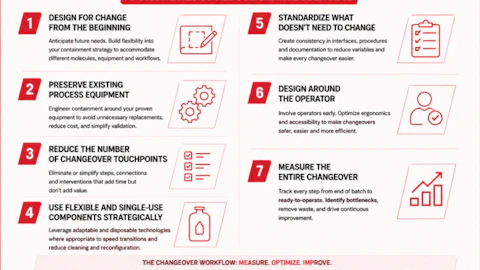
1. Design for change from the beginning
Changeover efficiency starts long before the first batch is manufactured. Containment systems designed around a single fixed configuration can perform exceptionally well for a specific process. The challenge comes when that process changes.
For CDMOs, the next manufacturing campaign may require different equipment, operator access points, material transfer requirements, or containment levels. That makes adaptability an essential design consideration from the outset.
When developing a containment strategy, ask:
- What elements of this workflow are likely to change?
- Which equipment may need to be exchanged?
- Where will operators need access?
- How will materials move into and out of containment?
- How easily can the system accommodate the next process?
Designing for the next changeover, not simply today's process, can help prevent unnecessary complexity later.
2. Preserve existing process equipment where it makes sense
Introducing a new manufacturing programme doesn't necessarily mean replacing existing equipment.
Many CDMOs already have mixers, mills, tablet presses, filling systems, vessels or other process technologies that operators understand and that have already been qualified or validated. Replacing them can introduce additional cost, training requirements and validation work.
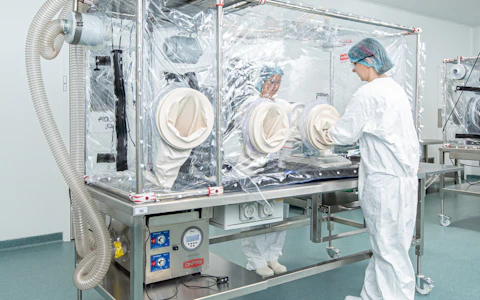
A containment strategy that can be engineered around those assets may reduce the amount of change required between programmes.
Instead of asking:
"How do we adapt our equipment to the containment system?"
Consider asking:
"How can the containment system adapt to our equipment?"
Flexible containment technologies can help manufacturers integrate containment around established workflows rather than forcing significant process changes. The less unnecessary disruption introduced into the manufacturing environment, the simpler each transition can become.
3. Reduce the number of changeover touchpoints
Every additional connection, component and intervention creates another task that must be managed during changeover. Individually, these steps may seem insignificant. Collectively, they can add substantial time, increase complexity and create additional opportunities for errors or contamination risks.
Map the entire changeover workflow and identify activities that can be eliminated, simplified or standardised. Consider:
- Material transfer points
- Equipment connections
- Glove and sleeve interfaces
- Cleaning activities
- Disposable components
- Equipment removal and replacement
- Operator interventions
- Verification and documentation
The objective isn't simply to perform each task faster. It's to reduce unnecessary tasks altogether.
4. Use flexible and single-use components strategically
Not every element of a manufacturing environment needs to be permanent. Flexible containment and appropriately selected single-use components can provide CDMOs with additional ways to approach campaign changes while maintaining containment performance.
Where appropriate for the process, these technologies can reduce reliance on permanent infrastructure and make it easier to configure containment around different equipment and workflows.
The key word is strategically.
Single-use and flexible technologies should not be implemented simply because they are disposable or adaptable. They should be evaluated based on:
- Process requirements
- Risk assessments
- Containment objectives
- Cleaning validation strategies
- Overall manufacturing goals
Used appropriately, they can become valuable tools for increasing operational flexibility while supporting contamination control and operator safety.
5. Standardise what doesn't need to change
Flexibility doesn't mean everything should be different for every customer. In fact, one of the most effective ways to improve changeover efficiency is to identify the elements that can remain consistent across programmes.
Standardised approaches to:
- Material transfer
- Operator access
- Containment interfaces
- Cleaning procedures
- Documentation
- Equipment connections
- Containment verification
can reduce the number of variables operators must manage during each transition. The goal is balance:
Standardize the repeatable elements.
Engineer flexibility into the elements that need to change.
That combination can make a manufacturing environment both efficient and adaptable.
6. Design around the operator
Changeovers are performed by people. That sounds obvious, but operator interaction can sometimes become secondary to equipment design.
If components are difficult to access, equipment is cumbersome to remove or connections are unnecessarily complex, every changeover becomes harder, slower and more prone to error.
Containment systems that reduce awkward reaching, complicated assembly steps and excessive glove interventions can improve both changeover speed and operator safety. Operators often identify inefficiencies that aren't immediately apparent on an engineering drawing. Involve them early.
Ask:
- What takes the longest?
- What is difficult to reach?
- Which steps are repeatedly problematic?
- Where do errors or delays occur?
- What would make the transition easier?
A containment strategy designed around actual operator workflows can improve usability, efficiency, and overall operational performance.
7. Measure the entire changeover
If changeover time matters, measure it. Not simply the cleaning step. Measure the process from the end of the last manufacturing campaign until the next manufacturing process is fully ready to operate.
Then break that time into categories:
Disassembly → Cleaning → Reconfiguration → Setup → Verification → Release
This helps identify where time is actually being lost. The bottleneck may not be where you expect.
Once the workflow becomes visible, engineering, manufacturing, quality, and EHS teams can work together to identify opportunities for improvement and prioritise the changes that deliver the greatest impact.
The bigger opportunity: Turn changeover into capacity
For CDMOs, reducing changeover time can create benefits far beyond operational efficiency. Shorter and more predictable transitions can help:
- Increase manufacturing capacity
- Improve asset utilisation
- Respond faster to new customer programmes
- Reduce scheduling disruptions
- Improve project predictability
- Support a broader range of manufacturing requirements
That makes changeover more than a manufacturing issue. It becomes a business issue.
Organisations that can transition efficiently between campaigns without compromising safety or containment performance are often better positioned to maximize available capacity and respond to changing customer demands.
Containment should enable change, not prevent it
CDMOs don't know exactly what the next molecule, customer or manufacturing programme will require. That's the nature of the business.
The most effective containment strategies don't force manufacturers to choose between flexibility and protection. They provide both.
Containment systems should protect today's process while preserving the flexibility needed for tomorrow's.
At ONFAB, we engineer flexible containment solutions that integrate with existing equipment, support changing manufacturing requirements and help organisations transition efficiently between programmes without compromising safety, containment performance, or operational productivity.